want to be a part of E. Salvador’s creative team? check out his patreon.

Script Type: Ceremonial Theater – 45 to 60 minutes
Through Lily’s Eyes: Where Will You Be is a Ceremonial Theatre work that blends movement, spirit beings, and intimate family drama. It offers powerful roles for women, centers cultural resilience, and invites audiences into a healing journey shaped by community, humor, and ancestral presence. The play is ideal for theaters seeking work that uplifts Indigenous voices and explores transformation through culture.
Synopsis:
In a small New Hampshire town, Simon and Lily share a world of wonder, imagination, and unspoken understanding. Simon is mute, but not silent; Lily is fearless, but not without compassion. When shadows in Simon’s home lengthen, the presence of Azeban and the Spirit of the Eagle guide them through a journey of identity, protection, and the immense power of being seen.
* This play contains depictions of domestic violence and emotional abuse (non-graphic), as well as themes of trauma, resilience, and healing.
Additionals:
- Production Notes
- Director’s Notes
- Dramaturgical Notes
Setting:
- Contemporary New Hampshire in a town along Route 28, with scenes in:
- Simon and Angel’s home
- Lily’s bedroom and studio space
- mystical realms shaped by Azeban and the Spirit of the Eagle
Themes:
- The power of community and culture to heal trauma
- The strength, protection and immense compassion of matriarchs
- Friendship as a catalyst for transformation
- The reclaiming of voice and agency
Cast of Characters: 4 Females, 2 Males, 3 Any Gender
Lily – 16 to 17 year-old – Native American – Lily is an exuberant 16-17 year old girl who loves life. She has started a podcast showcasing Native American music and puts it on regardless if people are listening. She is optimistic though she understands the reality of life as well. Lily absolutely adores Simon and wants to protect him whenever possible.
Simon – 16 to 17 year-old – Native American – Simon is a mute 16-17 year old. He feels people have trouble expressing himself due to not being able to speak. He loves his mother, Angel, though doesn’t understand why she allows his step-father to abuse them both. Simon has inner-strength, but has not found it yet.
Helen – 35 to 45 year-old – Native American – Helen is Lily’s mother who is an old friend of Angel, Simon’s mother. Lily knows about Simon’s home situation but is helpless to do anything. Helen is discovering more about her Native American heritage and finds solace within the ceremonies and teachings.
Angel – 35 to 45 year-old – Native American – Angel is Simon’s mother. Angel is addicted to drugs and alcohol trying to subdue the pain of abuse from her husband. Angel cares for Simon, but is too high to do anything for him.
Andrew – 40 to 50 year-old – Native American – Andrew is Simon’s step-father and Angels’ husband. To feel superior, Andrews physically abuses his son because he thinks Simon can’t talk.
Officer 1 – Any age adult – Any Race – Officer 1 is a competent police officer but understands very little about Native American life.
Officer 2 – Any age adult – Any Race – Officer 2 is a competent police officer, but understands very little about Native American life.
Spirit of the Eagle (Dancer) – 20 to 40 year-old – Native American – The Spirit of the Eagle is a dancer who interludes between the action on the stage. She represents balance, flow and unity among the people on the stage.
Azeban (Raccoon Puppet) – Any Age – Any Race – Azeban (Raccoon) is a trickster animal. He is portrayed by a puppet but has a wily personality. Azeban teaches lessons and portends things to come which may be dangerous.
Inspiration:
This was an original idea created from a writing prompt about Ceremonial Theater, a Native American art form.
Excerpt:
EXT. UNDER THE STARS
LIGHTS UP!A drum beat sounds as the 1st and 3rd beat of a four count. A lone female dancer, SPIRIT OF THE EAGLE, draped in a shawl reminiscent of eagle wings should be resting center stage. A guitar slowly plays a simple chord progression: bm – D – G- em or another simple 4 chord progression created by the cast. The ANGEL and HELEN come on stage and sing a simple vocable created by the cast. This song should be easily understood and teachable. ANGEL and HELEN teach the audience the song while the following takes place.
As the music continues the SPIRIT OF THE EAGLE should begin her “ascent” and dances around the stage. This should feel flowing and ethereal as well as make a connection to the audience.
After the SPIRIT OF THE EAGLE has created a moment of connection with the audience AZEBAN, the puppet, scurries on the stage. AZEBAN stares at the SPIRIT OF THE EAGLE in awe. As SPIRIT OF THE EAGLE moves around the stage AZEBAN changes position and stops and stares.
SPIRIT OF THE EAGLE and AZEBAN should look at each other in various spots around the stage. While this is happening ANGEL and HELEN should motion to the audience to stop the singing. After the audience stops singing ANGEL and HELEN exits the stage.
AZEBAN takes a bow and arrow and fires it at the SPIRIT OF THE EAGLE. LIGHTS OUT out as the arrow hits the SPIRIT OF THE EAGLE. The guitar continues to play during the blackout. After a moment the LIGHTS UP and AZEBAN is dancing on the body of the SPIRIT OF THE EAGLE.
The guitar stops as AZEBAN takes a bow. After AZEBAN bows he scurries off the stage.
LIGHTS OUT!
page 1
INT. INSIDE LILY’S BEDROOM
LIGHTS UP!LILY, a girl of 16, is at her desk. LILY is sitting in front of her computer, a camera, a ring light and a microphone. There is a projection of LILY from the POV of the camera. The song “Foot Prints” by Yes is playing on the radio and slowly fades away as LILY talks to herself. LILY is preparing to video herself for a podcast.
LILY:
Gotta check the levels. One, Two, One, Two. Things look good.
LILY makes some adjustments on the computer.
Testing. Testing. Bitter butter better butter beauty butter better batter. Test the tight tongue twister towards the tuna turner.
(singing)
“I believe the children are the future. Treat them well and let them see the way. Show them all the beauty they possess inside.”
LILY bends over to pick up a pen from the floor. After she picks up the pen she sets herself to start filming.
Here we go. And a one. And a two. And a three, two …
LILY nods her head for the next two counts. After she does her second head nod she hits the space bar on the keyboard.
Welcome back to Lily’s Eyes the only indigenous POV program recorded in my parents house in DerryView, New Hampshire, home of the jumbo popcorn shrimp from Helen’s Clam Haven on route 28. Today, like always, we are talkin’ music. Not just any music, but the music of “Native Roots.” You like indigenous music? You like reggae? You’re gonna love “Native Roots.” They are indigenous reggae. Let’s play a little “Frybread” before we take some phone calls …
(a beat)
Hold on a second. Our phone boards are blowin’ up. We need to release the floodgates and let the people talk.
page 2
(picking up a pretend phone)
Hello caller, You’ve got Lily. What good words can I say to you today?
(making a fake voice)
Hello, Lily! Long time listener first time caller. Just wanted to know about your homework. You keeping up on your grades?
(normal voice)
I’m glad you asked caller. Right now I’m behind on everything, but that’s OK. There is nothing in this world that can bring me down. I’ve got “Native Roots” coming up with a little “Frybread.” Hold the line as we raise the tunes and make everyone feel good about themselves.
LILY hits a button on her keyboard and “Frybread” by “Native Roots” starts playing. LILY gets up and starts to shuffle dance around her desk. LILY is visibly lost in the music. As the lyric “All I’m asking for is one more frybread” plays LILY stops dancing and looks out a window that is close to her desk. LILY returns quickly to her chair in front of the computer. The music lowers and LILY talks into the microphone in front of her camera.
Sorry for interrupting, dear listeners, but I just saw Azaban outside.
The AZEBAN puppet appears on stage right dancing to the music.
And when you see Azaban you know that means trouble is a brewin’. But don’t you worry, sweet listeners… there is nothin’ in this world that can bring us down when we have good native grooves.
The music swells and LILY starts dancing again. The lights fade out as the song continues. The AZEBAN dances in a solo spotlight. As the music fades away LILY’s desk is removed from the stage. On stage a representation of the front of a house appears. The AZEBAN scampers off the same side of the stage as SIMON walks on.
page 3
Production Notes
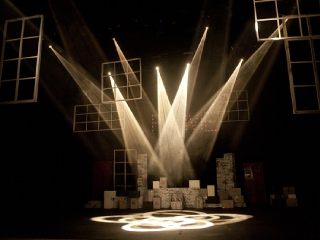
Through Lily’s Eyes: Where Will You Be is structured within the Ceremonial Theater framework and requires a performance environment capable of fluid transitions between domestic, natural, and mythic spaces. Scenic demands are minimal and rely primarily on lighting, sound, and performer movement to establish shifts in location and atmosphere. Azeban and the Spirit of the Eagle may be realized through live performers, masks, puppetry, or digital media, depending on available resources and the desired production scale. Simon is a mute character whose communication is entirely non‑verbal; the role requires an actor with strong physical expressiveness and the ability to convey emotional and narrative clarity without spoken dialogue. The script supports flexible casting configurations, including doubling, and is suitable for ensemble‑based work. The estimated run time is 45–60 minutes and is typically presented without an intermission.
Director’s Notes

Through Lily’s Eyes: Where Will You Be operates in a world where the physical and spirit realms are not separate but layered. These layers are always present; the difference lies in who can perceive them. Lily has grown up with access to this awareness. Her mother, Helen, carries only fragments of cultural knowledge — not because of uncertainty, but because so much was disrupted and erased through colonization. What she does know, she has passed on sincerely, and Lily’s ability to interact with these realities comes from that grounding.
Simon’s relationship is different. He was not raised with the same cultural access. Angel, Simon’s mother, carries her own trauma and disconnection, and the absence of cultural practice is a reflection of loss rather than rejection. Simon is mute, but not without voice; it’s just that his vision has been obscured because he has not been given the tools to recognize the world around him. His perception shifts after the smudging ceremony — not as a magical awakening, but as a reconnection to something that was always his.
Azeban and the Spirit of the Eagle should be approached as real beings within the world of the play. They are trickster and guardian archetypes and relations. Some audience members will understand their significance immediately; others may experience them without context. For the actors, these beings are not symbolic or metaphorical. They have agency, intention, and presence. Their interactions with Lily and Simon should be grounded in the logic of beings who exist alongside humans, not outside them.
The relationships between Helen and Angel form the intergenerational backbone of the story. Their friendship once held shared possibility, but their paths diverged as each navigated her own relationship to identity, survival, and cultural inheritance. Angel’s final choice — entrusting Simon to Helen — is rooted in her understanding of what she could not provide and what she hopes Simon can reclaim.
For the creative team, the guiding principle is this: the play does not shift between worlds. It reveals what is already there. The work is to honor the layered reality, the cultural grounding, and the emotional truth of two teenagers navigating identity, danger, and connection in a world that is larger and more alive than most people allow themselves to perceive.
Dramaturgical Note
Through Lily’s Eyes: Where Will You Be is grounded in a layered reality where the physical and spirit realms coexist. These realms are not symbolic; they are simultaneous and always present. The difference lies in who has the grounding or inheritance to perceive them.
Lily moves through this layered world with fluency because she was raised with cultural touchpoints passed down from her grandmother through Helen, her mother. As a character, Lily is grounded, intuitive, and emotionally present. She is confident without being hardened, perceptive without being cynical. Her ability to see Azeban and the Spirit of the Eagle is not a gift or a power — it is a natural extension of how she understands the world. She listens deeply, trusts her instincts, and moves through the play with a clarity and confidence that Simon is only beginning to discover. Lily’s perception reflects both this inheritance and Helen’s ongoing effort to reconnect.
Helen’s knowledge is partial not by choice, but because the community itself has lost access to much of its tradition — elders have passed, histories have been interrupted, and ceremonies have been obscured over generations. What Helen carries, she carries sincerely, and she continues to seek authentic knowledge where she can. Using what she knows, Helen becomes an Indigenously rooted guide who shares her knowledge freely, offering cultural grounding to both Lily and Simon.
Simon is mute and communicates through ASL, which becomes a limitation only because the world around him communicates differently than he does. His challenge is environmental, not internal. Simon is not disabled; he is enabled differently, expressing himself through presence, gesture, and embodied awareness rather than spoken language. He is perceptive, emotionally attuned, and deeply sensitive to the world around him — but he was not raised with cultural grounding.
Angel, his mother, carries a history shaped by trauma, survival, and addiction. These experiences led her toward apathy and disinterest in cultural practice, leaving little room for tradition or continuity. Angel loves Simon — fiercely, in her own way — but her personal choices and circumstances make her incapable of protecting him. This is why she becomes defensive with the police officers and why she speaks about Andrew’s abuse with a kind of obliviousness; she cannot fully grasp the danger Simon is in because she cannot fully face her own. Her disconnection is personal and circumstantial, distinct from the communal loss that shaped Helen’s experience. As a result, Simon grows up without the cultural access that might have helped him perceive the layered world around him. His awakening after the smudging ceremony is not a supernatural transformation but a reconnection to a part of himself that was always present but never nurtured.
Angel and Helen’s past friendship forms an important intergenerational thread. Their paths diverged as each navigated her own relationship to identity and inheritance — one shaped by partial knowledge and active seeking, the other by distance, survival, and the weight of addiction. Angel’s final choice to entrust Simon to Helen is both an act of surrender and her last, clearest expression of love: a recognition that Helen can offer Simon not only safety and stability, but a cultural identity she knows she cannot give him.
Azeban and the Spirit of the Eagle should be understood as real beings within the world of the play. They are trickster and guardian, archetype and relation — figures recognizable to those who know them, and compelling presences to those who do not. Their dramaturgical function is active rather than symbolic: they witness, intervene, disrupt, protect, and guide. They exist in the same world as the kitchen table, the bedroom door, and the stretch of Route 28.
At its core, the play explores identity carried, interrupted, and recovered; the ways perception is shaped by cultural grounding; and the quiet power of connection between two teenagers navigating danger, misunderstanding, and a world more layered and alive than most people are taught to perceive.